
Build Philosophy
The principles that guide every SugarTree build. Refined through experiment, failure, pivot, and reflection.
The Build System
A long-form walk through every consequential decision in a SugarTree build, and the physics or experience that justifies it.
Weight
Weight is the enemy of resonance and sustain. Every unnecessary gram is a gram the soundboard has to move. Every component decision — truss rod, neck wood, bridge, tuning machines, binding choices — gets evaluated through the lens of acoustic cost of mass before adoption.
This isn’t minimalism for its own sake. A heavier component that earns its mass acoustically (a denser bridge plate, a stiffer brace at a stress point) stays. A heavier component that doesn’t (a steel truss rod, an over-thick bridge, ornamental binding that adds nothing structurally) goes.
Neck Construction
Spanish cedar for the neck core — significantly lighter than mahogany, resonant, historically proven in classical construction. Excellent workability: carves, planes, and rasps cleanly. Stable when properly dried and quartersawn.
Carbon fiber hollow tube (10×10mm) in place of a steel truss rod. The tube is stiffer per gram than steel, has no adjustment mechanism to fail or be set incorrectly, no dead metal mass vibrating separately inside the neck, and transmits vibration more coherently with the surrounding wood. The hollow tube preserves bending resistance while reducing mass — the I-beam principle. A five-year-old dreadnought with this construction confirms long-term stability under steel-string load.
Ebony fretboard compensates structurally for the cedar’s softness and adds stiffness to the neck assembly. Fret slots are cut slightly thicker and stabilized with thin CA at each slot. All builds use Spanish heel construction — neck and body mechanically unified, no separate joint to slip over time.
Bracing
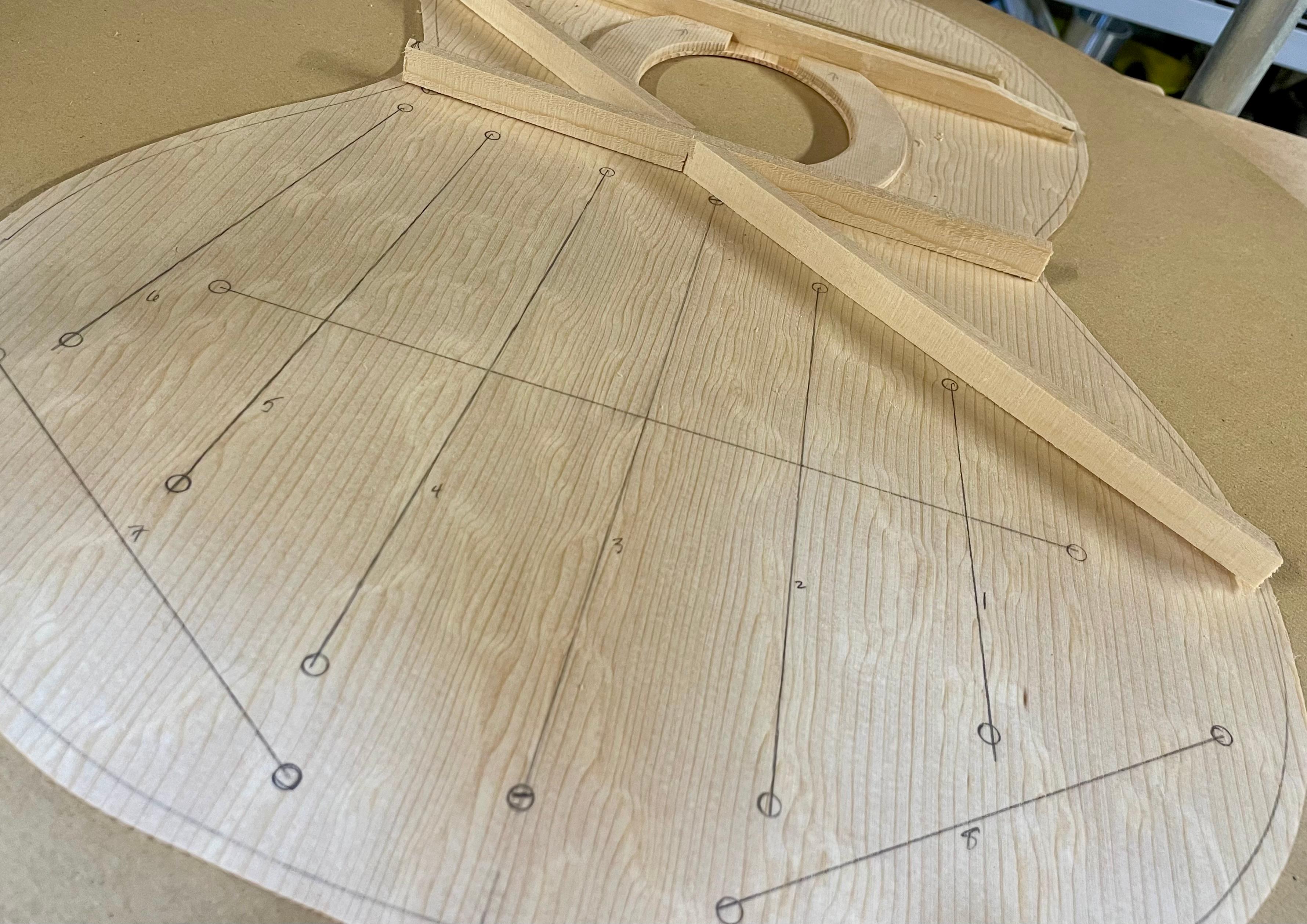
Forward shifted scalloped X bracing, with the X intersection moved toward the soundhole versus standard post-war practice. This increases the free vibrating area of the lower bout, improves bass response, and lets thinner tops produce more volume. It isn’t a new idea — it returns to pre-war building practice that was abandoned for production efficiency, not acoustic reasons.
Adirondack spruce for the main X braces. Tone bars and transverse braces sometimes paired with redwood — a split approach that gets tonal coherence without structural risk in the most stressed members.
Brace scalloping happens after gluing, with tap tuning at each stage guiding how much material to remove. The squeeze-out fillets at brace feet are left in place deliberately. They create a gradual stiffness transition between brace and soundboard, distribute stress, and are acoustically superior to a cleaned, sharp junction.
Glue Strategy
Hide glue for brace-to-soundboard joints specifically. It cures glass hard — harder than the surrounding spruce. The glue line is acoustically transparent: no damping layer between brace and top. The fillets at the brace feet cure rigid, contributing structurally as well as acoustically.
Titebond everywhere else. Longer open time, consistent viscosity, adequate reversibility, decades of proven track record. Old Brown Glue or fish glue serve as middle-ground alternatives where those properties are wanted without the hot-pot routine.
We’re skeptical of hide glue orthodoxy as a universal rule. We apply it where physics justify it — not out of tradition.
The Gobar Deck
Adjustable curtain rods, used as gobars. Each rod tuned individually by tactile feel — different pressure for different brace positions. A continuous bead of squeeze-out along the full length of every brace foot is the visual confirmation of complete joint contact.
Variable per-rod pressure is, in our hands, superior to fixed spring-rate gobars. The objective is uniform contact, not uniform force.
Soundboard
Thin tops, worked deliberately close to the structural limit. The top is held by the upper transverse brace during tap tuning — minimizing interference with plate response.
Tap tuning runs in three stages:
- Wood selection. Listening for sustain, clarity, and consistency across the plate.
- Flex feel after thickness sanding. Stiffness distribution, cross-grain compliance, safety check.
- Brace carving. An iterative conversation with the top. We stop when the wood says stop.
Cross-grained Adirondack bridge plate, 2.5mm thick, CA-hardened pin holes, edges beveled to soften the stiffness discontinuity at the perimeter. Positioned slightly toward the tail block. Cross grain stitches across potential split lines at the pin holes; same material family as top and braces means no impedance discontinuity.
Bridge
Ebony pyramid bridge, scaled to body size. The underside is relieved — material removed from the interior field, leaving a 3.5–4mm perimeter gluing border and full thickness preserved around pin holes and saddle slot walls. Relief depth is roughly 2mm.
The perimeter does the structural work, resisting the rotational pull of string tension. The interior field, once glued, contributes nothing structurally and only adds mass. Removing it cuts bridge mass 20–35% without reducing the gluing footprint. A lighter bridge accelerates faster — less energy lost in bridge movement — and the top moves more freely in the center zone.
One detail that matters: when clamping a relieved bridge, the caul must contact the perimeter, not the center.
Bone saddle, compensated for the specific scale length, minimum height for break angle, densest available blank.
Interior Philosophy
We don’t obsess over interior cosmetics. Joint integrity matters; appearance there does not. Vintage instruments that have aged into extraordinary voices were built the same way — rough where rough didn’t matter, precise where precision changed everything.
Tool marks, squeeze-out, minor irregularities: acceptable where they don’t affect the acoustic outcome. Precision is reserved for the places where precision changes the sound — not the places where it only changes the photograph.
Wood Selection
Tap tune and flex test before visual evaluation. Consistent grain and density over dramatic figure — highly figured wood introduces acoustic unpredictability and ages less consistently than ribbon-grain or straight-grain stock.
Sapwood is avoided: density difference, stability difference, finishing inconsistency. Quartersawn stock is preferred for neck and brace material. Plates that fail the tap test are rejected regardless of how they photograph.
For the long version of this thinking and the woods we keep on hand, see our tonewoods notes.