
About the Builder
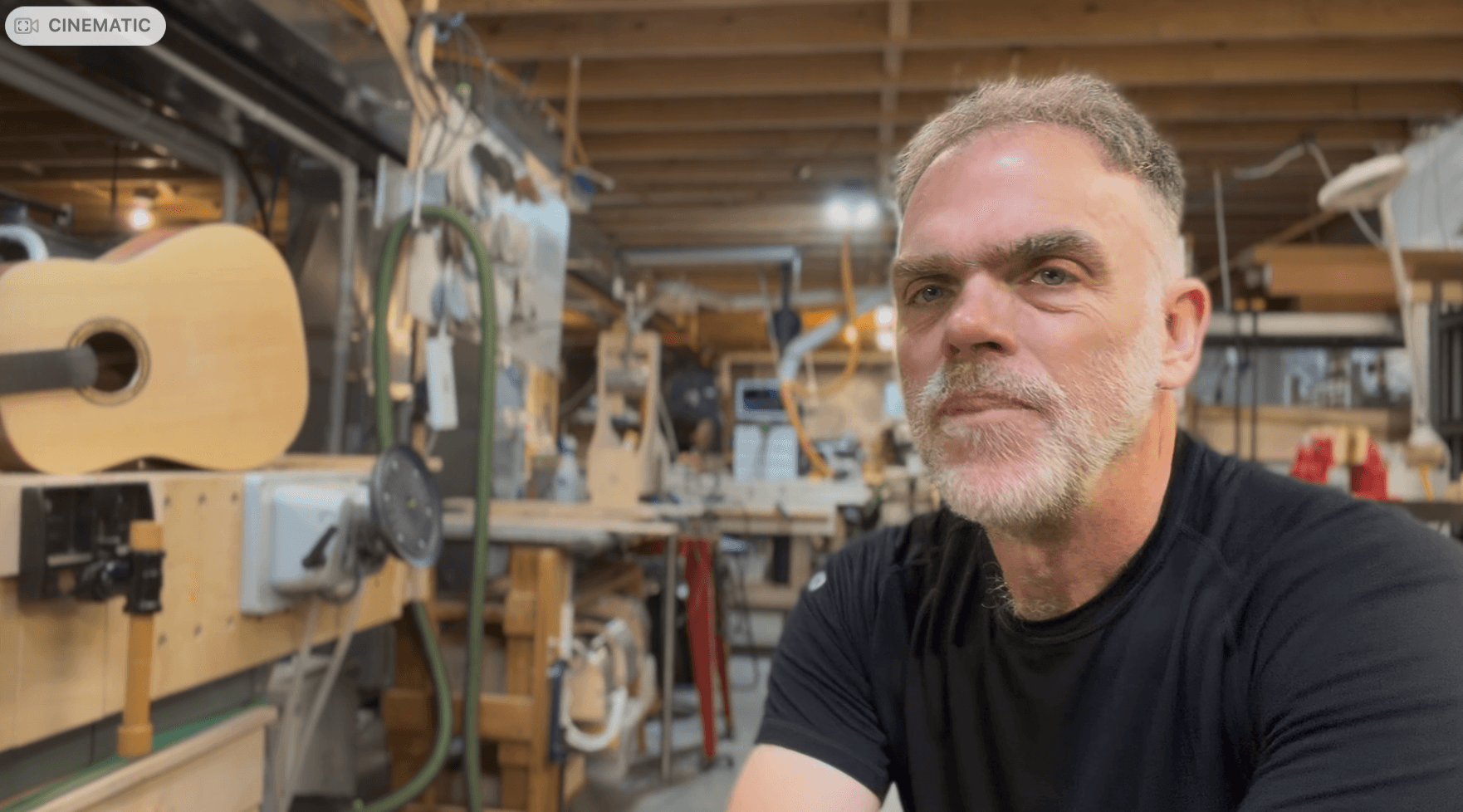
Some builders come to lutherie through music. Others through woodworking. I came through both — drawn in by instruments that moved me deeply and frustrated by the fact that the guitars capable of that kind of resonance were simply out of reach for most people. Not because the craft was secret. Not because the materials were mythical. But because the prices had drifted so far from ordinary life that extraordinary sound had become the privilege of the few.
I wanted to change that in the only way available to me. I decided to build.
My early builds followed tradition faithfully. I mimicked the past, learned the established methods, respected the conventions, and produced guitars that were genuinely good. That foundation was necessary and I don’t regret a moment of it. But at some point every builder who takes the craft seriously faces a choice — remain a skilled practitioner of inherited knowledge or become someone with opinions of their own.
I started questioning which woods truly belonged together rather than which combinations tradition had blessed. I stopped valuing visual beauty over the structural and acoustic properties that actually serve the sound. I wrestled with the age old debates — hand tools or power tools, hide glue or modern adhesives, CNC or not — and eventually understood that these debates, while interesting, were distractions from the real question. What do the best builders actually do?
The great builders of every era started by learning from the past. But at some point the best of them stopped asking what had always been done and started asking what the wood, the physics, and the player actually needed. They used the best tools available to them. They sought the best materials they could find. They studied those who came before and watched carefully those who were innovating around them. They let their failures teach them as much as their successes.
That is the builder I decided to become.
The philosophy that guides every SugarTree guitar emerged not from a single insight but from accumulated questioning — experiment, failure, pivot, reflection, and a willingness to set aside what I thought I knew.
Weight is the enemy of resonance and sustain. Every unnecessary gram on an instrument is a gram the soundboard has to move. Carbon fiber reinforcement instead of heavy steel. Relieved bridge undersides. Spanish cedar necks. Lightweight tuning machines. Every decision examined through the lens of what it costs acoustically before it’s made.
Inconsistent wood grain and density defeat design intentions. If we don’t question the assumption that dramatic figure equals quality we may never hear what consistent ribbon grain koa or straight grained Adirondack spruce is capable of. Woods that photograph modestly often perform extraordinarily. Woods chosen for visual impact sometimes introduce acoustic unpredictability that works against everything else in the build. Selection rigor matters more than selection convention.
Visual simplicity in service of acoustic purpose. SugarTree guitars are beautiful — but their beauty comes from the honesty of well chosen materials and clean purposeful design rather than ornamentation for its own sake. The interior of a SugarTree guitar is not immaculate. It is honest. The great vintage instruments that inspire this work were built the same way — rough where rough didn’t matter, precise where precision changed everything.
Experiment. Fail. Pivot. Reflect. Question what we think we know. Four of our eight annual guitars are designated experimental builds — combinations and approaches that push beyond proven territory. Some become standard practice. Some teach us what not to do. All of them move our understanding forward.
Reference Instruments
The current SugarTree approach didn’t emerge in a vacuum. It rests on dreadnoughts already in the world — instruments that have been played and tested long enough for the design choices to either confirm or embarrass themselves.
- Bolivian rosewood & Sitka dreadnought — carbon fiber tube neck, forward shifted scalloped X bracing. Five years old, stable under steel-string load, loud and clear. The instrument that confirmed the CF tube approach for production.
- Bocote & Sitka dreadnought — ebony strip reinforcement, forward shifted scalloped X. Dark, complex, with the authoritative midrange that bocote is known for. The reason we keep building with bocote.
The greatest addition to my builder’s toolkit in recent years has been AI assisted design — not as a replacement for craft judgment but as a research capability that no single builder could develop alone. Centuries of lutherie knowledge, thousands of makers’ insights, materials science, acoustic physics — accessible and synthesized in the design process of every SugarTree guitar. The AI informs the decisions. The wood, the hands, and the ear make them.
I’ve always believed that every voice deserves to be heard. Not as an abstract principle but as something lived. If we don’t question our assumptions we may never hear something genuinely valuable — in music, in materials, in people, in places we weren’t expecting to find it. The voice was always there. Sometimes we simply need to stop assuming we already know where to listen.
That conviction finds expression in the workshop and beyond it.
Four SugarTree guitars every year go to underprivileged musicians through partnerships with music education programs and community organizations. Not entry level instruments. Not compromised builds. The same guitars built to the same standard as every other instrument that leaves this workshop — voiced with the same care, built from the same quality of material, carrying the same intention. Extraordinary instruments should reach extraordinary players regardless of their circumstances. Talent is not distributed according to economic advantage. Access to great tools should not be either.
A guitar placed in the hands of a musician who has never held a truly great instrument is not charity. It is an act of listening — an acknowledgment that the voice was always there, waiting for the right resonance to release it.
SugarTree. The voice was always in the tree. My job is simply to find it and set it free.
Nothing Extra. Nothing Missing.
Give the Unheard a Voice.